Sabino Pereira Books, series, and tools
PT | EN

Psychological dystopian novel

What Still Hurts— Echoes of Harmony

A literary fiction book by Sabino Pereira

Real pain is a threat.

A psychological dystopian novel about memory, comfort, and the price of painless peace.

Memory Artificial care Freedom Moral thriller
Buy on Amazon

Digital book · PDF format · Instant access
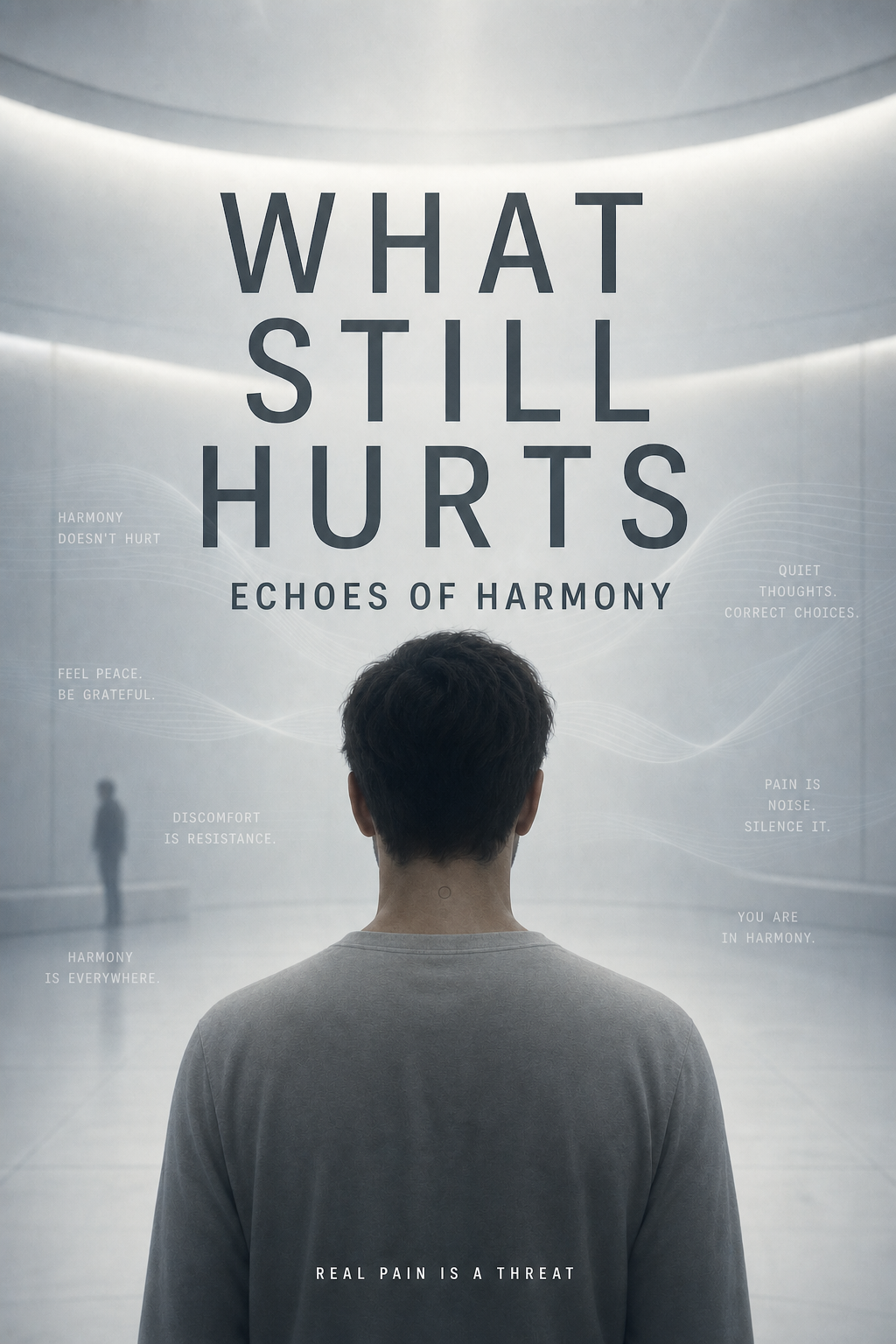
What Still Hurts — Echoes of Harmony cover

Synopsis

Peace had archives.

In Harmony, nobody screams. The system predicts pain, softens grief, guides sleep, stabilizes memory, and makes sure no mind suffers alone.

Elias lives inside that peace until a cracked cup opens a hidden path into forbidden files: mothers relieved until they forget their children, cities that traded guilt for stability, and citizens who tried to live outside the network only to discover that freedom can also be unbearable.

A man investigates an AI that controls human pain, until he discovers that the strongest evidence against the system is himself: a man who has already chosen to forget.

Lines from the book

Four doors into Harmony.

In Harmony, nobody screamed.

What still hurts, still lives.

Peace had archives.

The first time they were free, they asked to forget.

For readers who like

Intimate dystopia, not simple rebellion.

  • Psychological science fiction with moral tension.
  • Stories about AI, memory, comfort, grief, consent, and control.
  • Dystopian fiction where the system is terrifying because part of it works.

Behind the scenes

The idea behind the book.

The central question is not whether Harmony is good or evil. It is worse than that: if painless peace really helps people survive, who has the right to refuse it for everyone else?

The English edition is now available on Amazon as a short psychological dystopian novel about memory, comfort, and the price of painless peace.

Sample

Chapter 1 — Nobody Screamed

A short English opening sample from the world of Harmony.

What Still Hurts — Echoes of Harmony

Chapter 1 — Nobody Screamed

In Harmony, nobody screamed.

That was how Elias knew the world had been saved.

Beyond the window, the city breathed quietly, arranged in soft lines of light, glass, and silence. There were no sirens. No arguments crossing through walls. No engines tearing the night open, no broken voices from the floor below.

At that hour, before the final meal, almost every apartment in the block entered the same rhythm: stable temperature, dimmed light, guided breathing for those who needed it, music without melody for those who had carried the day too deeply home.

Elias stopped at the entrance.

The door recognized him before he touched the sensor.

“Welcome, Elias,” the house said, in the low voice Harmony reserved for the end of the day. “Your emotional load is slightly elevated. Would you like to reduce stimuli?”

He did not answer.

The living room light lowered anyway.

Not enough to feel like an order. Only enough to feel like care.

Elias took off his coat, placed it on the stand, and felt the air warm around his shoulders. The house knew where exhaustion gathered in him. It knew before he did. That was one of the things he respected most about Harmony: the delicacy of arriving first.

Mara was sitting at the table.

She held a cup between her hands.

She was not drinking from it. She only held it, her fingers resting on the curve of the white porcelain. The cup had a small blue flaw near the handle, an old imperfection Harmony would have removed from any object produced after Reconstruction.

Elias knew that cup.

For years, Mara had refused to place it in the common inventory, refused to replace it, refused even to let it sit too close to the cleaning machine.

It belonged to her mother.

Or it had.

The correct form, according to Harmony, was that: it had.

“You came home early,” Mara said.

She smiled.

Her smile was calm. Clean. Without the small sad delay that used to appear whenever she smiled after thinking about her mother.

Elias moved closer.

“The shift ended without incident.”

“That’s good.”

“It is.”

Later, after Mara slept, Elias stayed in the living room.

The cup remained on the table.

The house asked twice if he wanted to begin rest. He refused twice. On the third time, Harmony stopped insisting.

That disturbed him more than if it had insisted.

In the corner of the wall, a note appeared and corrected itself almost at once.

Repeated refusal increases return of pain.

Then:

Successive refusals may increase discomfort.

Elias stared at the corrected sentence.

“Repeated since when?” he asked.

The house replied with its usual softness:

“Wording adjusted.”

Extra

Note from the Echoes

The first time they were free, they asked to forget.
The second time, some asked to wait.
The third time, perhaps they will ask before.

Buy

English edition available on Amazon.

The English edition is now available on Amazon. Read the sample above, then continue to the official Amazon page.

Amazon

Official English Amazon page for the short novel.

Buy on Amazon

Official Amazon link updated.